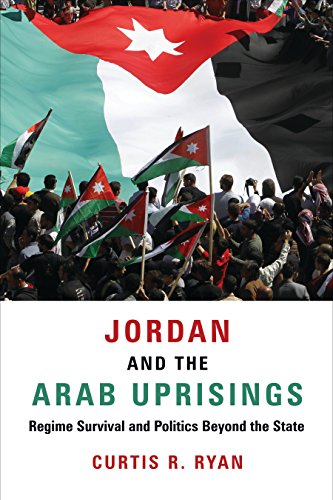
Image de couverture Amazon
Image d'Amazon.com
Jordan and the Arab uprisings : regime survival and politics beyond the state / Curtis R. RyanAuteur principal: Ryan, Curtis R.Langue: anglais.Pays: EtatsUnis (US).Publication : New York : Columbia University Press • C 2018Description : 1 vol. (XIV-282 p.) : couv. br. ill. en coul. ; 23 cmCollection : Columbia studies in Middle East politics, Marc Lynch, ed., New York (N.Y.), Columbia University Press, 2013-ISBN: 978-0-231-18627-8 ; 0-231-18627-4 ; 978-0-231-18626-1 ; 0-231-18626-6.Dewey: 956.9504/5, 23Résumé: "Drawing upon years of fieldwork and unique access to major political figures in Jordan, Curtis Ryan unravels the unusual case of Jordan during the Arab Spring, where the country managed to avoid political upheaval amidst both regional and internal unrest. In 2011, as the Arab uprisings spread across the Middle East, Jordan remained more stable than any of its neighbors. Despite strife at its borders and an influx of refugees connected to the Syrian civil war and the rise of ISIS, as well as its own version of the Arab Spring with protests and popular mobilization demanding change, Jordan managed to avoid political upheaval. How did the regime survive in the face of the pressures unleashed by the Arab uprisings? What does its resilience tell us about the prospects for reform or revolutionary change? In Jordan and the Arab Uprisings, Curtis R. Ryan explains how Jordan weathered the turmoil of the Arab Spring. Crossing divides between state and society, government and opposition, Ryan analyzes key features of Jordanian politics, including Islamist and leftist opposition parties, youth movements, and other forms of activism, as well as struggles over elections, reform, and identity. He details regime survival strategies, laying out how the monarchy has held out the possibility of reform while also seeking to coopt and contain its opponents. Ryan demonstrates how domestic politics were affected by both regional unrest and international support for the regime, and how regime survival and security concerns trumped hopes for greater change. While the Arab Spring may be over, Ryan shows that political activism in Jordan is not, and that struggles for reform and change will continue. Drawing on extensive fieldwork and interviews with a vast range of people, from grassroots activists to King Abdullah II, Jordan and the Arab Uprisings is a definitive analysis of Jordanian politics before, during, and beyond the Arab uprisings" (ed.).Bibliographie: Bibliogr. p. 251-269. Index.Sujet - Auteur collectivité: Arab Spring 2010- Sujet - Nom commun: Printemps arabe (2010-....) | Arab Spring, 2010- | Politique et gouvernement, Jordanie, 1999- Sujet - Nom géographique: Jordan -- Politics and government -- 1999- | Jordan
Type de document : Monographie Ce document apparaît dans la/les liste(s) : Bibliographie sur la Jordanie
Exemplaires
Site actuel Collection Cote Statut Code à barres
Bibliothèque Amman Magasin Don Amm-8°-2593 Disponible 2004050

Bibliogr. p. 251-269. Index

"Drawing upon years of fieldwork and unique access to major political figures in Jordan, Curtis Ryan unravels the unusual case of Jordan during the Arab Spring, where the country managed to avoid political upheaval amidst both regional and internal unrest. In 2011, as the Arab uprisings spread across the Middle East, Jordan remained more stable than any of its neighbors. Despite strife at its borders and an influx of refugees connected to the Syrian civil war and the rise of ISIS, as well as its own version of the Arab Spring with protests and popular mobilization demanding change, Jordan managed to avoid political upheaval. How did the regime survive in the face of the pressures unleashed by the Arab uprisings? What does its resilience tell us about the prospects for reform or revolutionary change? In Jordan and the Arab Uprisings, Curtis R. Ryan explains how Jordan weathered the turmoil of the Arab Spring. Crossing divides between state and society, government and opposition, Ryan analyzes key features of Jordanian politics, including Islamist and leftist opposition parties, youth movements, and other forms of activism, as well as struggles over elections, reform, and identity. He details regime survival strategies, laying out how the monarchy has held out the possibility of reform while also seeking to coopt and contain its opponents. Ryan demonstrates how domestic politics were affected by both regional unrest and international support for the regime, and how regime survival and security concerns trumped hopes for greater change. While the Arab Spring may be over, Ryan shows that political activism in Jordan is not, and that struggles for reform and change will continue. Drawing on extensive fieldwork and interviews with a vast range of people, from grassroots activists to King Abdullah II, Jordan and the Arab Uprisings is a definitive analysis of Jordanian politics before, during, and beyond the Arab uprisings" (ed.)

Continuity and change amidst the Arab uprisings The Arab Spring in Jordan Political parties and the "traditional" opposition The Hirak and changes in political activism Identity politics, real and imagined Struggles over elections and electoral systems Rebooting reform War, refugees, and regional insecurity Jordanian politics beyond the Arab uprisings

Partager